Welcome to my story! Read, share, and enjoy my musings!

21 November 2011

Floating the Mekong

DAY 1

Another slowboat passing us on the river.
A gray haired man teases a small Lao girl with a leopard puppet. The prowling hand-cat lurches out across the space between them and then retreats as the young girl giggles gleefully. Her brilliant white hat bobs back and forth as she mirrors the faux predator’s movements, leaning out into the aisle and then huddling back for cover. Mom watches with smiles.
Golden afternoon light cascades through the glowing cabin. Pale gold tassels dangling from drapes shift and shine in the breeze and reflected sun. The motor thrums in the stern. Eddies and waves caress the hull and return to the river.
A man works on his boat in the setting sun.
Women clean grains in wicker baskets at the water’s edge while their children wave frantically to boats passing by. Hamlets tucked beneath crumbling limestone walls appear cut off from everything but the river. The jungle swells around rock and home.
Small canyons and tributary valleys spit streams, tumbling waterfalls down stepped rock embankments and into the Mekong, the mother river.
Children roll down sand dunes in their underwear, then climb hand-and-foot back to the top to do it again. They tug at their friends and siblings, good natured pushing and shoving. They spin with flying roundhouse kicks and lift their shirts over their heads.
Water buffalo sleep in the sandy floodplains, their ears calmly and resolutely flicking away insects. Grazing cows navigate crumbly cliffs to get to the river’s bank and have a drink.
Bright red flowers adorn an otherwise leafless tree. It’s stark white bark shines out into the valley, an absence of color amidst a saturated landscape.
The reverie is intermittently interrupted as speedboats buzz by, their passengers’ faces cloaked in masks to keep off the foam, spray and wind.

DAY 2
A riverside golden abode.

Heaping sandbars pile up out of the water’s edge, the work of countless years of molding, carving, and transporting by water. Their steep flanks are pockmarked with prints of all the valley’s inhabitants, two-legged and four-, wild and domestic, as all flock to the river as a source of life, the central artery of existence.
An elephant lopes along the shoreline, his mahout treading behind him. Gray, fleshy, muscled legs carry his lumbering mass while sail-like ears flop and flutter in the valley breeze. The imagined thumping of his great flat feet syncs in time with the firing pistons of the slowboat engine. A wondrous mammal.
Bones, turrets, spines of dragons, molars and canines of rock jut up from the swirling waters. The boat deftly navigates the otherworldly obstacles.
The largest land animal lopes along.
White, yellow, black, and orange streaked karst towers erupt from the dense green landscape, crowning the horizons and crowding the river. A small temple with Buddha images is tucked into a large cave in a cliff. White washed steps lead up into and then past it. Monks wait in longtail boats below.

28 September 2011

The Beauty

Forty-five granite steps climb above the green to the temple’s face. Three segments of thirteen steeply inclined stairs make their way to the uppermost platform upon which Dabosa sits. Six more footfalls take the walker to the temple structure's great doors. Dark, thick bee sap falls from the awning and collects in a gooey splat, feeding hordes of well-nourished ants. Detailed paintings of Buddha's life adorn the interior walls, a story laid out beneath a ceiling saturated with lotus flowers. Finely carved wooden dragon heads spiral above the focal effigy of Buddha. Paper lanterns and flowers hang from the ceiling, white and pink and bright, hovering above the meditation cushions.
Looking down on the residence and dining hall from Dabosa
Dabosa is nestled amidst thick forest that clings to the steep Sobaek Mountains of central South Korea. Sandy bedrock cliffs jut out of the canopy like spots of skin revealed beneath the furry green coat. Small farms and a narrow road tuck in alongside the clear creek that carves the valley. All the eye sees is forest, rock, cloud and sky in all directions, the vista enveloped and protected by Sognisan National Park. The ear is treated to the almost electric whirring of cicadas from mid-morning on with the accompanying chorus of birds, bees, and breeze through the trees. It feels like a long way from anywhere, and indeed the bus ride here ferried me through endless landscape paintings of rivers and hills, sparse settlements and fields of crops three and a half hours from the capital city of Seoul in the north.
Eight times a day I ascend to the meditation hall, beginning pre-dawn under the starlight, continuing through sunrise and the heat of mid-day, with the final trip after nightfall as the cool mountain air permeates camp. The slow climb encourages a focused entry into the coming sit, a preparation for the internal work I am about to do. The even slower descent is a product of the radical pain flaring through my knee joints, a byproduct of sitting for long hours and releasing the hellfire from within (more on that later).
Yinchuan, China in May
At the base of the steps is a small lawn, partitioned into two for male and female usage. Upon this lawn the participants of this ten day meditation course saunter, stroll, pace, power walk, lope and do laps. There is no contact permitted between students. This includes speech, eye contact, gesturing and physical touch. We are prohibited from writing, reading, and engaging in essentially anything that would distract us from the work we have come here to do: sharpening and purifying the mind.
With all of these distractions removed, and still having free time between sits, naps, and eating, I delve into the rich life of my surroundings. Giant frogs, tree frogs, mini-toads, dragonflies, ugly-butts, cicadas, praying mantis, long-green-legs, ants, spiders, and bees. The small green metamorphoses into an insanely interesting and incredible insectorium filled with hours of entertainment and rumination.
A small cord bisects the lawn, keeping the (human) sexes segregated. The local dragonfly population has noted the perfect positioning of this line and its members sit perched upon it, using it as a hunting platform from which they can launch and devour their prey. I encounter one just as he touches down on the cord, the head of a sizable gnat in his mouth. The legs of his captive kick in constant struggle as he slowly munches away, jaw extending down and away from his oblate head and engulfing bit by bit the gnat’s entire body. Legs continue to flail as the transparent wings pop off as if they were connected by cheap, desiccated glue. The dragonfly works his mouth unhurriedly. The gruesomely fascinating display bolsters my recent decision to relinquish my own carnivorous habits.
Where do sunflower seeds come from?
I am particularly fond of the dragonflies. They are stunning creatures, clothed in a broad spectrum of spectacular colors, crimson flowing to burnt orange and radiating gold, amber speckled with jade, lightning bolt yellow across a body of black. And their relative ease with my proximity offers the opportunity for extreme close-ups and advanced scrutiny. Their head is quite large, and the neck by which it is attached to the rest of the torso surprisingly small. Their eyes are massive, dusty and opaque, the color of rust at the apex, and becoming increasingly metallic and mirrored toward the base. They have an endearing way of cocking their head to the side while they view you, somewhat like a dog does when it hears a perplexing sound, but considerably more buggy in character.
A much less aesthetic member of the lawn community is the ugly-butts, as I have so named them because they have ugly butts. They appear to be a blend between malnourished bumblebees and elongated horseflies, though fortunately with neither the biting nor stinging capacity of their unlikely relatives. They are hairy, with bristles covering the rear half of their body and sprouting from between their eyes. In flight their wings produce a sound like a giant mosquito, and their skinny little hairy butt rises up in the air akin to a scorpion’s tail preparing to strike. This style of flight strikes me as particularly ungainly and gross.
What I assume to be the males are infinitely occupied with finding a mate. They have a white film oozing from the tip of their rear, which is likely some kind of sperm/egg/or supercharged hormone they wish to swap with a member of the opposite sex. Perched upon a step, rail, or other elevated surface, they scout for ladies who may be huddling in the grass. Bullying is standard to maintain a good viewing platform, and fisticuffs erupt whenever one’s zone has been infiltrated by another.
At Seolleung Royal Tombs, Seoul
When finally a mate is selected, they link butts. This ritual grossly lacks style and grace, in stark contrast to the mating dance of the dragonfly. Stacked one on top of the other, the dragonflies both face the same direction and hover in unison, apparently enjoying their brief union. Grounded or aloft, the pair moves together as a unit. The ugly-butts apply no such form to their reproductive function. Facing away from their ugly partner, the only thing connecting the two are their hairy rear ends. When forced into flight, one dangles behind the other and struggles to flap its wings, producing a sickly dissonant hum as it flies in reverse. Most unpleasant to behold.
At the base of the stairway leading up to Dabosa sits a giant granite urn. Functioning as a cistern to catch rain-water for use by the residents of the grounds, the half-spherical stone goblet spills overflow into a smaller rectangular basin and then out again into a drain. At the very rear of the urn is a small hole, which I presume connects to a well that plunges into the bedrock below. Seeing no pump, I wonder if it is an artesian well. In that tiny hole lives a small frog, jade green and very cute.
My good friends Lena and Derek in Shanghai
She remains settled back in her niche through the heat of the day, but in the early and late hours when the air is ripe with insects to be plucked, she edges herself out to the brim of her abode and snipes unsuspecting bugs mid-flight. She is rather skittish and my multiple attempts to approach her have all been rebuffed. I’m guessing she’s already taken.
The next morning I come across a small praying mantis upon the white and black crystalline stone. Leaning close to deepen my inspection, I note how wobbly he looks when he walks, with such a wobble you could call it a hobble. He has none of the speed or precision of the little mantis from Kung Fu Panda, and I wonder why a world renowned martial art would want to emulate such an awkward looking creature. I briefly consider trying to roundhouse kick him to see how he may counter my attack, but seeing as that may distract the other meditators I decide to refrain. I watch him penguin-mantis walk a little further, as if on two peg legs that have been overly worn down and need replacing, and then leave him to his mysterious training regimen.
You are probably wondering what kind of “sharpening” and “purification” (heavy emphasis on the quotes) of mind I am doing when it seems that my only achievement is a reversion to a childlike simplicity of thought. But this in itself is part of the work I am doing: to be present in this moment. To be here now. To see the beauty and richness of that which surrounds us, and to dive in and relish it as a child would. To embrace the beginner’s mind, as Shunryu Suzuki describes it.
And when we begin to see the fullness of the now, the brimming juices flowing from every experience, we find that what we have is more than sufficient. That wonder exists in the mundane. That a walk to the store contains an epic poem beyond the Odyssey in scope, and that a slice of watermelon is so saturated with ecstasy that my roommate Dan can’t resist polishing one off in only two sittings (he’s a pretty happy guy). That we can find our own Eden in our backyard, in our everyday.
Friend and fellow meditator Sasha in Seoul

But these realizations take work. We have been trained out of seeing things with this vision. We wander aimlessly in the misty, tangled cloudforests of our past and the shifting new moon shadows of our future. We rush through our days to get to the next five p.m. clockout, weekend or vacation.
So we must work to retrain our minds, to remind ourselves how to be aware. There are a multitude of phenomena that reach our sense organs every moment, and produce unconscious responses in the body and mind. To begin to observe that flow of input and response is the key to gaining deeper insight into how we act and behave. To understand ourselves and our environment. As Deepak Chopra describes, our bodies are a “cosmic computer,” through which we can listen to the song of the universe. With such a magnificent melody forever engulfing us, how could we instead choose to don our i-Pod ear buds or let our smart-phone multi-media digital machines suck us in?
The work is not easy. To return to the aforementioned hellfire; I am beginning to gain some understanding of the commonly used Christian terms of purgatory and hellfire. They always appeared to me to be scare tactics to frighten the listener into living a moral life based on the effects in the afterlife. Sin and you will wander the barren plains of purgatory, somewhere between heaven and hell, cold and alone. Or worse, be scalded, boiled, burned, and tortured in the ever plunging circles of Lucifer’s inferno, according to your crime.
But to believe that we must wait until death to reap the fruit of our action (whether sour or sweet) is an illusion and disservice. Anger burns within this body, and the products of this fiery furnace, all soot, smoke and ash, absolutely manifest in my daily mental state and course of action. Buddha described anger as a hot coal in a fire that we have picked up, planning to throw at someone or something, the object of our rage. Yet the coal never truly leaves our hand, as the seething emotions are never truly delivered to their target, and we boil inside just as the hot coal burns flesh.
King Sejong the Great, who created hangeul, the Korean alphabet, seated in Seoul
When the anger is not observed and let go, it gets stored in our body, in our unconscious mind, as a habit pattern of response. The storage tanks of the unconscious are vast and deep indeed! So when I sit, and observe what I feel and experience in this moment, both in body and mind, the old anger bubbles up, boils up, and manifests as very real hellfire throughout my body. Oftentimes the flames of pain lick around my knees and ankles, shooting up and down my legs as if I am stewing half-submerged in a cast-iron cauldron.
I use anger here because it is my strongest negative emotion with which I battle. Others will likely experience other strong negative emotions that overpower them from time to time. And often our unchecked emotions push us away from those we care about, in the form of open conflict or through the more subtle workings of pride and envy. Ultimately we can even lose ourselves in these experiences, not understanding why we feel a certain way or being confused about an irrational act or statement. Why am I so agitated? How could I hurt someone I love like that? And is this not purgatory, wandering alone through life, without even the solace of the self, an understanding of our own inner workings?
The beauty and richness of life and the world we live in is here. We just have to start seeing. The light and strength and love are within all of us, we just have to start believing. And then when the path is revealed to us, we just have to start walking.
As S.N. Goenka says, “only you can work out your own liberation. No one else can do it for you.”

12 September 2011

A Wrinkle in Time

After deboarding, visa administering, and a gut wrenching race to the squat toilet, I am approached by a man garbed entirely in pink. Glowing softly in the afternoon light, he asks me if I want to buy slow-boat tickets to Luang Prabang, two days downriver from Houaysai. I say yes indeed, I need two. I unload what seems like an absurd amount of money, hundreds of thousands of kip, having just exchanged my Thai baht for the considerably more inflated Laos kip. He tells me to show up tomorrow at the pier west of town. I tell him I want a receipt. And then watch him run away up the street with our cash.
The slowboat that will take us to Luang Prabang

Mildly perturbed by his hasty departure with such a massive wad of our funds, I walk back to where Erin is lazing and inform her of the interaction. She appears unfazed. Something about the quiet river and her disposition and the air hanging about us just oozes with relaxation. So I succumb to this unseen power and plop down to await our fate.
The man in pink soon returns with the desired documents, bids us a pleasant evening, and wanders off on some further entrepreneurial endeavor.
Ascending from the riverside we come to what appears to be main street. A quiet avenue with shops lining both sides, people leisurely walking and talking, a few vehicles scattered about. The two story buildings along the narrow roadway show the gentle touch of time, built with native construction materials and indigenous architecture. A bucolic riverside town.
Laotion flags hang above the pier
There is also a stillness in the air; as if upon uttering a word it gets sucked into a vacuum and disappears. I find myself speaking in whispers so as not to disturb the tranquility, the soft silence. Chiang Kong’s previously pleasant hustle and bustle now seems harsh and strident, a bare cement room of rebounding acoustics compared to this comfortable den of throw pillows and drapes.
There is a profound feeling of having traversed back in years, the Mekong functioning as a portal between ages, a wrinkle in time.
We pass a brilliantly painted gateway marking the entrance to a long flight of stairs ascending a hillside. The undulating walls adjacent to the steps are forest green dragon torsos, their gaping white-toothed maws and wide-eyed faces spilling out onto the street where we stand. Young monks in bright orange robes traverse the upper reaches towards the dragons’ tails.
We continue on to seek lodging.
***
Dusk approaches and the serpentine barriers guide us onward and upward. Our feet carry us up the long flight of low angle steps while child monks play with cell phones and harass each other nearby. At the terminus appears a central temple surrounded by a courtyard and a ring of smaller structures. Some serve as living quarters and dining areas for the young inhabitants, and others contain golden images of Buddha, his disciples, and various figures I don’t recognize.
Dragons leading a large ritual vessel, Wat Xieng Thong, Luang Prabang
Several of the buildings have intricate, striking paintings on their outer walls, linking traditional Buddhist images with animistic influences. Like many regions that Buddhism traveled to after leaving India, the pre-existing local beliefs were integrated into the new faith, creating a geographically and culturally unique strain of the religion. The elemental, protector, and malevolent spirits of Laos animism shape local belief systems, and more than half of Laos’ present population practices some form of animism. The artistic style of these paintings reflects a raw kind of pulsating energy, with bold colors and defiant figures. Quite different from the generally more subdued and refined art I saw in Thailand.
Erin and I wander separately about the grounds, taking in the various features of the temple surroundings. I amble around the front of the building and gaze upon the lazy Mekong below, breathing deeply as the red orb of the setting sun approaches the horizon in the distance. Suddenly, swarms of young monks come scurrying from all corners of the compound, answering the bell calls emitting from the center hall. I make my way toward the main entrance of the temple proper and look in at the young ones seated in front of a tall Buddha statue. Some fidget in the back while others settle onto their cushions toward the front.
An elder monk guides the congregation and they begin to chant.
Buddha images at Wat Xieng Thong
The combined voices rumble through the sacred space and pour out into the twilight. Their words carry weight, and I can feel them press over my body. I am moved to sit on a stone step at the temple’s edge and close my eyes, absorbing only the sound and shutting the other sense doors. The mutterings resonate through my eardrums and fill me up, an empty vessel slowly becoming saturated with warm vibrations. Aromas of incense and night time flow into my nostrils. I sway gently to the song of the youthful, the faithful.
A timeless trance.
When the chanting halts, I open my eyes. Unable yet to move from my perch, I mirthfully observe the interested and genuinely surprised stares from the children as they file out around me. Erin is gone. In time I stand and begin to walk slowly down the hewn steps. I glance once more at the hill top refuge and move quietly into the comfortable darkness.

03 September 2011

Crossing the River

Mountains and jungle, streams and plain blur by for hours. Small limestone escarpments jut out from the forest, tangled roots and vines leaping from the cliff tops to the forest floor below. Small villages and fields of assorted crops spring into being whenever the mountainous landscape subsides. Dusty roads bud off of the main track, wandering outward. Our put-putting bus crawls up and over steep mountain passes, and often walking seems like a swifter option.
Looking across the Mekong to Houaysai, Laos.
Having flown from Krabi Province to Bangkok, and then taken a night bus from the capital to Chiang Mai, I had yet to see much of Thailand’s countryside by the light of day. Rolling along through this lush landscape, I begin to fill the gaps in between the destinations, to better understand the makeup of the landscape and envision what the lives of the people must be like.
Chiang Kong is the final stop. The mighty Mekong cuts along the northern edge of town, and Laos begins on the opposite bank. The People’s Democratic Republic of Laos, and specifically the village of Houaysai, is our destination for the evening but lunch comes first. Having foregone any serious breakfast and it now being well into the afternoon, we are famished. We wander about until finding a small pair of tables and chairs under an overhang, bedroom visible in back, small kitchen spilling out into the street.
A lovely old woman offers us a seat and I take the final opportunity to indulge in some (more) Pad Thai while still in the dish’s motherland. Glorious rice noodles, bean sprouts, and lime! Erin laughs at the little dogs trotting the streets, adorned in extremely diverse size, pattern, and color sweaters. She has been fascinated by the absurd quantity of sweatered dogs since Chiang Mai (this is a tropical country), and has proposed several times to chronicle the Thai sweater-dog culture in a photo-essay. I offer my full support and she grabs her camera and chases out into the street for a coveted shot.
Our boatman prepares to guide us across the water.
Supplementing our extremely limited Thai with large smiles, we thank our hostess and move on. A final Thai Tuk-tuk trucks us to the boat ramp. Stamps and nods, passports in hand we hop into a longtail boat, my first international river crossing. This passage also marks my return to the Mekong and my fifth crossing of this mighty river, although the first along the water’s surface.
Three years ago, I undertook two separate journeys into the high peaks of northwestern Yunnan Province, where the Mekong (known in China as the Lancang Jiang) runs swift and narrow through the towering Hengduan Mountains, and along the eastern flank of the sacred mountain Kawagebo. Throughout this region, giant snow-capped peaks descend dramatically thousands of meters into narrow gorges where some of Asia’s greatest rivers rage in close proximity. The Mekong, Salween (Nu Jiang in Chinese), and Yangtze Rivers flow southward off the Tibetan plateau through this extreme landscape, running parallel to each other in a three hundred kilometer corridor. The region is recognized as a UNESCO World Heritage Site and protected area for its amazing topography and rich biodiversity.
Gateway to another realm.
Each crossing of the river was a unique and transformative experience. The first began with perceived threats from some drunken Tibetans with a club, a forced march across the prayer flag-laden bridge in the middle of the night, and ended with shots of baijiu (rice liquor), cigarettes, and chatting about Saddam Hussein in their military surplus tent on the banks. The third crossing was the starting point of the circumambulation of Kawagebo. I was left standing on the eastern bank, dropped by a bus in what seemed like the wrong place. Despite my misgivings, I traversed the footbridge to find three large waterfalls cascading down the walls of a narrow canyon cutting into the mountains, as if a gateway into another realm. Awe-struck, I left the churning Lancang Jiang behind and headed up-canyon on what became an epic journey. The fourth occurred while I was stuffed in the back of a multi-day bus, a stowaway amidst bulging, dirty baggage and sweating Tibetans, so I have no recollection of the actual moment we crossed the river. I was being smuggled out of a closed region of Tibet by my friends and guides I met on the pilgrimage, the final stage of that rigorous journey. The following morning I awoke at sunrise to look across the deep cleft of the Lancang River valley to the sacred peak I had connected so deeply with, shining white in the morning light.
The motor of the longtail fires up and our boatman shoves us off. Four weeks in Thailand come to a close. As the river surrounds us, I reflect on my shared past with the mighty Mekong, and smile at this infinitely more casual crossing of the calm waters, sitting comfortably with a friend, legally entering and exploring a new land, a new people. I run my fingers through the cool, muddy waters, and excitedly await whatever the opposite bank holds for me.

20 July 2011

Of Monks and Motorbikes

The fat, yellow moon fills my one open eye. A heavy blink brings temporary darkness, though the giant cheese ball remains imprinted on the back of my lid. The cool glass against my face feels refreshing after Bangkok’s oppressive heat. Though other oppression has followed me onto the bus. A rowdy, obnoxious mob of what I infer to be Israeli boys has taken the rear portion hostage, and are blaring music through crappy speakers, shouting, swearing, boozing heavily, and overtly harassing nearby passengers. The tension is palpable. As if it weren’t difficult enough to sleep on a cramped overnight bus, we now have these idiots throwing a rager in the rear. My foggy brain attempts to let go of its anger, and the bulbous sphere hovering on the horizon once more fills my thoughts.
---
“Do you climb?”
Erin aloft at Crazy Horse.

At first I don’t hear the question. I am so wound up with internal voices screaming at each other, that her soft voice is drowned out by the cacophony. The harsh light of the gas station convenience store adds to my general feeling of confusion.

“Excuse me, do you climb?”

I snap out of it and realize she’s talking to me. I slowly remove myself from my internal argument and look down at the smiling girl standing before me. I learn her name is Erin (serendipitous), that she is a climber, and like me, without a partner. She had noticed my Craggin’ Classic t-shirt (an annual climber’s party held in the US) and inferred my rock scaling, anti-gravity status. My hard shell begins to soften as we talk pleasantly in the cool mid-morning hours, waiting for the bus to fire up its engine.

After some deliberation, we decide to be buddies.
---
The wind and open road flush the exhaustion from behind my eyes. As does the uncertainty and consequent adrenaline associated with operating a motor vehicle in a foreign country. Getting out of the city had been a bit frantic, but now, with the countryside opening up around us and rolling forested mountains stretching off into the haze, my nerves begin to settle.

I had lied to the rental guy to dispel any concerns he might have regarding my gross inexperience operating a motorbike, but that lie did not quell our own worries. I’m nervous, and Erin knows it. She put a large portion of trust in her new, admittedly weary friend (our friendship is approximately 11 hours young at this point) by hopping on the back of a motorbike with him to head out into the unknown. But she is supportive, encouraging me when I do something well, and softly redirecting me when a plan of action appears unsound.

Getting to the crag where we intend to climb is no small feat. There are a number of formidable obstacles to be overcome before we arrive at our goal. The first, and most stark, is driving on the left-hand side of the road. A new and novel concept for my first international driving experience. Not such a big deal when going straight, but considerably more so whenever turning. Taking now more risky right turns rather casually, and then forgetting which lane I am supposed to enter into, until I face a head-on truck approaching at high speeds to remind me, is a very real problem.

The trucks are the second major hurdle. Very large, very erratic, with absurdly loud horns that nearly knock one off their bike by the sonic wave released. We have already thrice been nearly hit, and once almost forced off the road by a merging truck drifting off the shoulder and into the dirt, seriously compromising our position on the asphalt.

My new friend and traveling partner, Ms. Erin Babich.
The third is the ever-present pot-hole. Some merely uncomfortable to hit; others reminiscent of the giant sand-pit monster that Jabba the Hutt throws Luke Skywalker into in The Return of the Jedi. Minus the teeth and tongue, they are a little less frightening, but then again I have no light saber to defend myself with. I do my best to avoid these savage beasts altogether.

But whenever Erin and my lives are not being threatened, I begin to better appreciate my father’s love for motorcycles and their transformative effect on the automotive experience. I had tasted it before on the back of his Harley while we toured through the Catskills of New York, the road mere inches from our feet, with the soft green mountains rolling by in the golden afternoon sunlight. Everything had felt more real, more vibrant, when not enclosed by a box of steel and fiberglass. My memories of that ride are vivid and fond.

And now I am living it, at the helm myself for the first time. Captain of my vessel. Awake and alert upon my steed. And thankfully alert, as I dodge another motorbike-eating maw with too sharp of a trajectory adjustment, made known to me by Erin’s tightening grip around my waist. Struggling to regain stability, her large, gear-filled backpack becomes a highway-bandit that has mounted the vehicle from behind and is trying to pull her off. Its sheer size and excessive weight rocks and sways, bounces and jostles any time my novice handling skills make too sudden a movement. Erin also kindly head-butts me any time I decelerate too rapidly to let me know that I have made an error in my calculations.

With the help of these indicators I hone my craft.

Smoke billows out of the fields as farmers burn their excess chaff after harvest. The sky is thick with particulate haze, and the sun burns orange overhead. The mountains, indistinct in the heat and ash-cloud, begin to crowd in on us, and we spot our destination. A small buttress of limestone jutting out of the bamboo forest. Crazy Horse.

I grip the accelerator and thrust us onward.
---
The sun brightens the hall while we sit in silence. The rising sounds of morning fill the air outside. Birds chirping, chittering, squawking. Some totally unfamiliar to my ears, yet still uplifting and enlivening as any dawn birdsong.

After our morning session concludes, I walk outside into the courtyard to take in the new day. The fresh, glowing, solar orb is just creeping over the horizon line and the buildings are awash in warm light. The various representations of Buddha lining the northern perimeter of the square erupt in golden brilliance, their subtle features made bold and distinct in the low angle rays.


I am at the International Meditation Center, outside of Chiang Mai, during a four day retreat for foreigners. The course is run by monks from Wat Suan Dok in the city center, where the Mahachulalongkorn Rajvidayalaya Buddhist University (MCU) is based. No idea how to say that. Monks from all over Southeast Asia come to this university to study various aspects of Buddhism and earn academic degrees that they can then apply in their home communities. During a regular evening meeting called Monk Chat, Erin and I visited Wat Suan Dok and spoke with monks from Thailand, Burma, Cambodia, Laos, and Vietnam, who were all attending the university and eager to speak with us and share their experiences. The free sessions are an opportunity for monks to practice their English and for foreigners to learn more about Buddhism and monastic life.
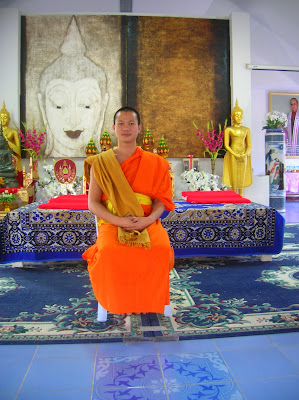
Phra Sinlapachai at the International Meditation Center.
Our instructor, Phra Sinlapachai, was born in Chiang Tung, Burma and has been a monk for eighteen years. He is earning his Master’s degree in Buddhism at MCU and intends to continue with doctorate study in India. Phra Sinlapachai then wishes to return to Burma to help his own people, augmented by his stronger understanding of Buddhist scripture and theory. At present he is excited to help with the meditation courses for foreigners because he realizes many of us are interested in Buddhism and would like to learn more, but may not have the opportunity in our home countries. He believes many people suffer from materialism in our modern time, and wishes to help them however he can through these courses.

I am finding this course to be a welcome return for me to deeper spiritual practice. Learning new techniques in a peaceful environment with an opportunity for focused practice has been very grounding. It is part of a larger transition out of Colorado and into Asia, where I intend to continue shedding the excess from my life, and bring a smaller number of important things to the forefront of my focus. Coming to this course has been a major step toward that goal.

The stillness of the morning breathes calm into my heart. The life breathes energy into my skin. I walk slowly and deliberately, eyeing the intricate details of the golden statues, the buzzing bees visiting the tender pink-white flowers adorning the bushes along the walkway. Peace infuses this place, and the people fortunate enough to come here.
---
I am shocked and angry.

I try to remain aware of how I am feeling and let it pass, but my frustration builds despite my attempts.

Relatively well-educated, well-traveled, privileged people, who came here to learn, to experience Buddhism and meditation, are attacking their teacher. Verbal assaults are flung from all about the room. Our daily group chat sessions, supposed to be focused on the technique and any troubles associated with it, have metamorphosed into an outright siege on the foundations of this nation’s religion.

It has become West versus East; the Religion of Science versus the Religion of Buddha; Logic versus Faith. The farang (Thai for foreigner) have found Phra Sinlapachai’s explanations of Buddhist theory to be unsuitable, and now seek to deflate and expose it.

With extreme disrespect, the group follows the lead of a Brazilian man and a French man in aggressively seeking Western answers to Eastern concepts. But when Phra attempts to explain, they are unsatisfied with the answers and press further. Language barriers plague the exchange. English is many of the attendees’ second language, and few take into account Phra’s ability to cope with their complex questions.

Many of their queries could have been answered by their own personal study, and when Phra does not understand what they are asking I occasionally step in to offer what I know from previous readings. A few other meditators (in particular a woman from Australia and a man from Quebec) who have had previous experience in the tradition also add voices of reason to the debate.

But the overwhelming atmosphere is one of confusion. Emotions are flung while concepts are lost in translation. Travelers from the USA, Canada, France, Russia, Brazil, Australia, Sweden, Spain, and the UK are continually frustrated and unsatisfied by the responses our teacher gives to their pressing questions. Fifteen examiners to one defendant, the inquisition unfolds.

My anger continues to build over the days as our group conversations emerge as the most difficult and challenging aspect of the course for me.

The meditation hall at the Center.
The echo of misunderstanding reverberating through this hall dedicated to unity and internal peace is a disturbing one. The Eastern hand reaches out and the Western tongue lashes back.
---
Cruising through the city on our rented motor bike, we pass monks and prostitutes, temples and bars, farang and local shopkeepers. The old city walls and its encircling moat are now surrounded by traffic and all forms of combustion engine. Curry and incense hang thick in the air. Golden parapets and ornately adorned gates cluster around modern high rises.

Having gotten slightly more comfortable in the Thai traffic, I weave in and out of lanes, lights, and throngs of pedestrians. The cool morning air fills my clothes and my nostrils, my visor up and open. Erin casually watches the scene unfolding around us, intimately, as only a passenger on a bike can do. Fountains send airborne spray out of the moat. Multi-colored taxis and Tuk-tuks vie for position with horn and bumper.

We get lost among the narrow alleys, slanted side streets, and crowded corners one last time.

07 July 2011

Independence Day

A flickering projection on a dissipating screen.
Once strong, distinct, pure.
Now vulnerable, alone, true.
Unthinking choices constructed of old assumptions
Throw an image at the sky.
With nothing to project upon
The night eats her illusion,
The shimmering stars empty and hollow.

Open the door, walk inside
The furnishings are absent
The pictures of her past life are shadows frozen in frames.
The walls are gone,
The beams are rotten.
Standing on the floor now standing on the earth.
Inside the house is the forest.


Charging blindly onward
The thorns tear at flesh.
Stepping carefully backward
The soft under-side of the leaf
Caresses the nape of her neck.


She turns about and the forest is gone.

Who is now is not who was,
She tells herself.
Confuses herself.
Scared she does not know
She weeps.

The tears are not.
She does not wipe them.
They roll off her face
Fall away to the earth.
Dry salt upon her lips.

The silence behind the tears
The quiet behind the eyes
Choicelessly watching the air pass over her wet
       cheeks
Now dry and flaky.
Her face falls away
Shedding skin, shedding body.
Molting in the moment.

The space around blurs
As she expands into it.
She touches and becomes,
Breathes and is.
Not doing what she did,
Only doing what she does.

Pale starlight fills her.
She fills the sky.

Free.

03 July 2011

Shiver me Limbs!

The end of June, 2011.

I meet Phil in the early morning hours after buying some fruit and fried breads. We cruise through the already bustling streets en route to our bus, which will take us up to 三关口 (Sanguankou) our climbing destination for the morning. We arrive at our stop, and entertain a number of taxi drivers and pedestrians by our mere presence. They quickly endeavor to assess our equipment, its integrity, and how much it cost us. Hands begin passing over bike frames, checking the suitability of the padded seat, honking horns and ringing bells, gauging the value of each item as if they were preparing to auction it off in a few minutes time. Several men cycle through to lift and assess the weight of each (conveniently undertaken after we’ve already taken off our panniers). 不太重 (bu tai zhong), “not too heavy” is the verdict.
Phil and I prep the bikes to go under the bus, which he informs me may not happen at all if the driver is feeling particularly prickly that morning. Seats down, wheels off, bags off; all amidst the constant banter and questioning of our audience. They want to know where we’re going, what we’re doing, what everything cost, if we’re married. We try to keep track of our dismantled components in the crowd, all the while trying to put back a 包子 (baozi) or two, steamed buns with a variety of filling. This morning I went with the 韭菜 (jiu cai) a garlicy oniony vegetable that’s quite tasty.

My buddy Richard and my bikes on the road.
The bus screams up and the ticket lady ambles off  to appraise the situation. Phil and I quickly dive under the bus, rearranging all the luggage to suit our needs. Ticket lady laughs as I sprawl prone in the belly of the beast, shuffling this bag there and that sack there. Soon we establish a sizable alcove and stack our bikes underneath. We leave our peanut gallery on the sidewalk to harangue the next passing 外国人 (waiguoren), foreigner, that passes by, of which there are few in the city of 1.5 million.

On the road, we settle sleepily into our seats, passing idle chat and the remaining 包子 between our teeth and along our tongues. Phil regales me with harrowing adventure tales of gnarly whitewater and flipped kayaks in the Alps, round-the-world airport scrambles, and a Guatemalan bus station that defines the word chaos. I enjoy the tales as the 贺兰山 (helan shan), Helan mountains, climb into sight, capped in cloud.

The 西夏王陵 (xixia wangling), Xixia tombs, one of the area’s biggest tourist attractions pass into view on the scrub plain. Mausoleums constructed over a thousand years ago to safely encapsulate some dead ruler or another, the earthen beehives are a stark contrast to the surrounding flats (“a pair of muddy nipples,” according to Phil). I watch them float by against the overcast backdrop as the bus banks westward to the mountains.

Standing atop the Great Wall at sunrise.
Soon we pass through the old Great Wall, stamped earth that has lasted since the Ming Dynasty constructed it in these far western reaches of their empire seven hundred years past. And then we are off the bus, in a cold gusting wind blasting down from the mountains. Clad in shorts and t-shirts, us mountain hardy fools neglected to bring much of anything warm. To add to the fun, the clouds are descending upon us, and drops begin to fall from the sky. We smile stupidly and hop on our steeds.

The headwind is large, and we could walk faster than we are pedaling. With only a couple kilometers to go before turning off the pavement, we bend our heads into the breeze and will our legs to work. They fight back. They refuse. Muscular mutiny. And I just fed them! Ungrateful bastards.

At our wash winding out of a steep canyon, we turn onto the sharp cobbles and debris and pedal shakily past goats, sheep, and a farmer/shepherd before finally dismounting when pebbles turn to boulders. Lock the bikes to a tree, grab our bags, and we’re off!

Dodging a few rocks kicked down on us from the local fauna, we wind up canyon around sharp dry bends in the river bed and arrive at our cliff. Phil’s crag is quite nice, being so close to the road and rather accessible. He and his compatriots are likely the only hands and feet to have scaled this wall, and he affectionately tells me how he has named several of the climbs after a busty friend’s cleavage and crack.
Sunset east of the Yellow River.
The hike up has warmed us, but it is by no means comfortable. The warmth quickly evacuates our bones as we harness up and eyeball the wall. I offer to lead a climb, and am soon awkwardly scaling a crumbly, dusty crack with two questionable pieces of gear, sharp rock, and dirt in my eye. I love it. As I pull out of the dihedral on broken rock, with little behind me that would remotely catch a fall, I am shakily reminded how and why I love climbing so much. I slowly set up an anchor at the top and peer back down at Phil, still belaying me, and wrapped in a brilliant neon pod from head to toe. Ordinarily functioning as a waterproof cover for his bike packs, he has converted this blindingly bright shell into a kind of cocoon, and looks quite happy about it. Dancing around in the canyon bottom, trying to stay warm, with a huge shit-eating grin on his face, I can easily see how he and I would naturally become good friends.

A bit more grabbing and high-stepping later (technical terms for climbing), and it’s raining. Sideways. The wind is now punching across the mountain side, left hook, right jab, right up my shorts. We decide it might be a reasonable time to head home. So we scramble back down the slippery rock to assemble our gear and say goodbye to the crag for the day.
Camp along the Great Wall.

We wheel our bikes back to the road, mount up and begin our initially slow roll down the hill. Phil crams the last of his 包子 into his cockpit and we begin to pick up speed. The drenched asphalt could have bred concern of hydroplaning, but instead Phil and I glimpse an opportunity of reduced friction to go as fast as we possibly can to get the hell down to some warmer pastures. Whirring wheels and water sailing through the air accompanies our rapid acceleration to 60 kmh as we play leap frog with freight trucks coming down from the mountains.

The air warms rapidly and we are soon too hot. Back in the flats we resume casual conversation as we pedal toward a noodle joint for some sustenance for our ride back to 银川, Yinchuan, our home. All in a good morning’s fun.
P.S. As usual, I forgot to take photos this trip, so the photos posted are from a cycling trip a couple weeks prior.